Uneven concrete around a home or commercial property is more than a cosmetic issue. A sunken driveway panel, sidewalk, patio, garage approach, or walkway can create trip hazards, collect water, and make an otherwise well-maintained property look neglected. The good news is that settled concrete does not always need to be demolished and replaced.
In many situations, concrete lifting—often called slab jacking—can raise an existing slab back toward its intended elevation. For property owners in Surrey, Vancouver, Burnaby, and across the Lower Mainland, understanding when lifting makes sense can help avoid unnecessary demolition, cost, and disruption.
Why concrete slabs settle
Concrete is strong, but the soil supporting it can change over time. Settlement commonly occurs when fill beneath a slab was not compacted adequately, when water washes fine material away, or when soil shrinks and shifts. Poor drainage can make the problem worse by repeatedly moving water beneath or alongside the slab.
The result is often a void beneath part of the concrete. Once the slab loses uniform support, its own weight and normal traffic can cause it to drop or tilt.
How concrete lifting works
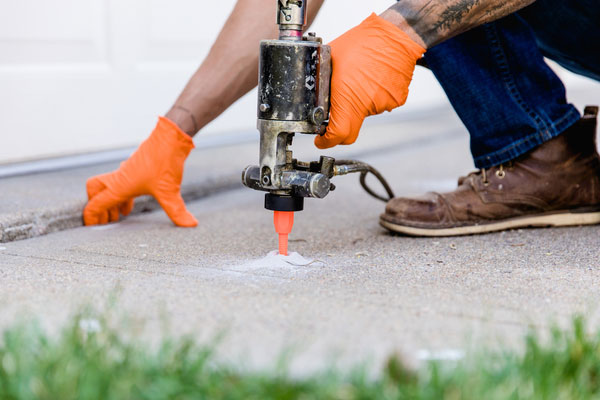
Concrete lifting is intended to correct settlement without removing the entire slab. Small access holes are made in the existing concrete, and lifting material is introduced beneath the slab to fill voids and raise the panel in a controlled manner.
The exact process depends on the system being used and the condition of the concrete. The objective is not simply to push a slab upward; it is to restore support beneath the concrete while carefully controlling elevation so adjoining panels, doors, curbs, drainage paths, and other fixed points are considered.
When slab jacking is a good candidate
Lifting is most attractive when the concrete itself is still structurally serviceable but has settled. A driveway panel that remains relatively intact but sits lower than the neighbouring panel, for example, may be a much better lifting candidate than a slab that is severely cracked and breaking into multiple pieces.
Common applications can include driveways, sidewalks, walkways, patios, garage approaches, warehouse or commercial slabs, and other accessible concrete surfaces. Each project still needs to be assessed individually because slab thickness, access, underlying conditions, cracking, and surrounding structures can affect the approach.
When replacement may be the better option
Concrete lifting cannot repair every problem. If a slab has extensive structural cracking, severe surface deterioration, major spalling, or has broken into unstable sections, raising it may improve elevation without solving the underlying condition of the concrete.
Replacement may also make more sense when the original slab was installed with an unsuitable slope or layout. Lifting can correct settlement, but it cannot always redesign a slab around fixed elevations and drainage constraints.
A responsible assessment should therefore look at both the concrete and the reason it moved before recommending a repair method.
Drainage should be part of the conversation
If water contributed to settlement, correcting the elevation without considering drainage may leave the underlying cause in place. Downspouts, surface runoff, grading, leaking services, and water flowing toward slab edges are all worth reviewing.
For BC properties that experience long periods of wet weather, controlling water around exterior concrete is particularly important. The repair plan should consider where water will travel after the slab is raised rather than focusing only on making adjacent panels level.
Benefits of lifting existing concrete
When the slab is a suitable candidate, lifting can preserve concrete that still has useful service life. It can also reduce demolition debris and avoid the larger work area associated with removing, hauling, forming, pouring, and curing replacement concrete.
Because every site is different, the best option should be based on slab condition and site constraints rather than assuming lifting or replacement is always superior.
Concrete lifting from Division 7 Contracting
Division 7 Contracting provides concrete lifting and slab-jacking solutions for residential and commercial properties in British Columbia. If you have settled concrete, we can review the slab condition, access, surrounding elevations, and likely repair approach before work begins.
Learn more about our concrete lifting services on Division7.ca or contact Division 7 Contracting to discuss your project.
Frequently asked questions
Can cracked concrete still be lifted?
Sometimes. Minor cracking does not automatically rule out lifting, but severely broken or deteriorated concrete may be a better candidate for replacement.
Can concrete lifting fix drainage problems?
Correcting slab elevation can improve surface drainage in some situations, but the source of excess water should also be investigated.
Is every sunken driveway suitable for slab jacking?
No. The slab condition, amount of settlement, access, fixed elevations, and underlying site conditions all need to be considered before choosing a repair method.
Leave a Reply